
₿"We Won. (Please Pay in Bitcoin.)”Edition
In a stunning victory for American diplomacy, President Trump successfully negotiated the reopening of the Strait of Hormuz down from over 100 ships per day to approximately four. On Wednesday. Four ships. The ceasefire has been in effect for one full day.
Those four lucky vessels were permitted to hug the Iranian coastline through a corridor between Qeshm and Larak islands, coordinating with the Revolutionary Guard—an organization the U.S. and EU designate as a terrorist group—and paying fees of up to $2 million per supertanker, in either Chinese yuan or cryptocurrency, arranged roughly a week in advance. Ships from countries aligned with the U.S. or Israel need not apply.
Meanwhile, on marine VHF radio Wednesday morning, Iran was broadcasting a helpful message to all vessels in the Persian Gulf: ships without Revolutionary Guard permission risked being destroyed. This is what a ceasefire sounds like, apparently.
Trump, having demanded the strait’s reopening as his central condition for stopping the war, celebrated by reposting Iran’s foreign minister’s statement—the one outlining Iran’s military control of the strait—on social media. The White House also reposted it. Presumably as a victory lap, though it reads more like the terms of a surrender.
To recap what six weeks of war achieved: before the conflict, ships moved freely through the strait under international maritime law. Now Iran’s parliament has passed a formal management plan institutionalizing tolls, the Revolutionary Guard controls access, payments flow in Chinese yuan, and Oman, which opposed the war but got bombed anyway, is being pressured to take a cut. Iran, despite absorbing five weeks of U.S. and Israeli strikes, has emerged with a brand new revenue stream, a chokepoint on 20% of global oil, and expanded geopolitical leverage. In other words: Iran found something better than nuclear weapons. It found a toll booth.
Secretary of State Marco Rubio acknowledged the tolls are illegal under international maritime law, then suggested that Europe and Asia—the countries most dependent on the strait—should probably do something about it. The U.S., he indicated, doesn’t need to lead on this one. Bold posture from the nation that just started the war.
The closure is already driving up global food prices, threatening semiconductor supply chains (the strait carries helium), and choking off 38% of the world’s seaborne crude. Shipping companies are sitting still, waiting for clarity that isn’t coming. Crew members stranded in the Gulf say they’ve received no guidance whatsoever on whether it’s safe to move.
The bottom line: America achieved overwhelming air supremacy over Iran, then negotiated a ceasefire in which Iran controls the sea. The strait is “open” in the same sense that a store is “open” when a man with a gun is standing at the door deciding who gets in and what they pay.
But don’t worry. Talks resume Friday. In Islamabad. Led by JD Vance.
Sleep well.
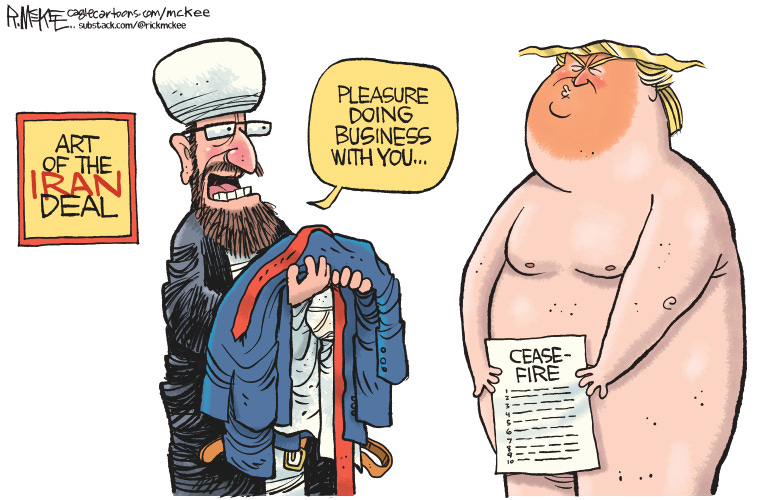
Rick McKee - cagle.com/mckee
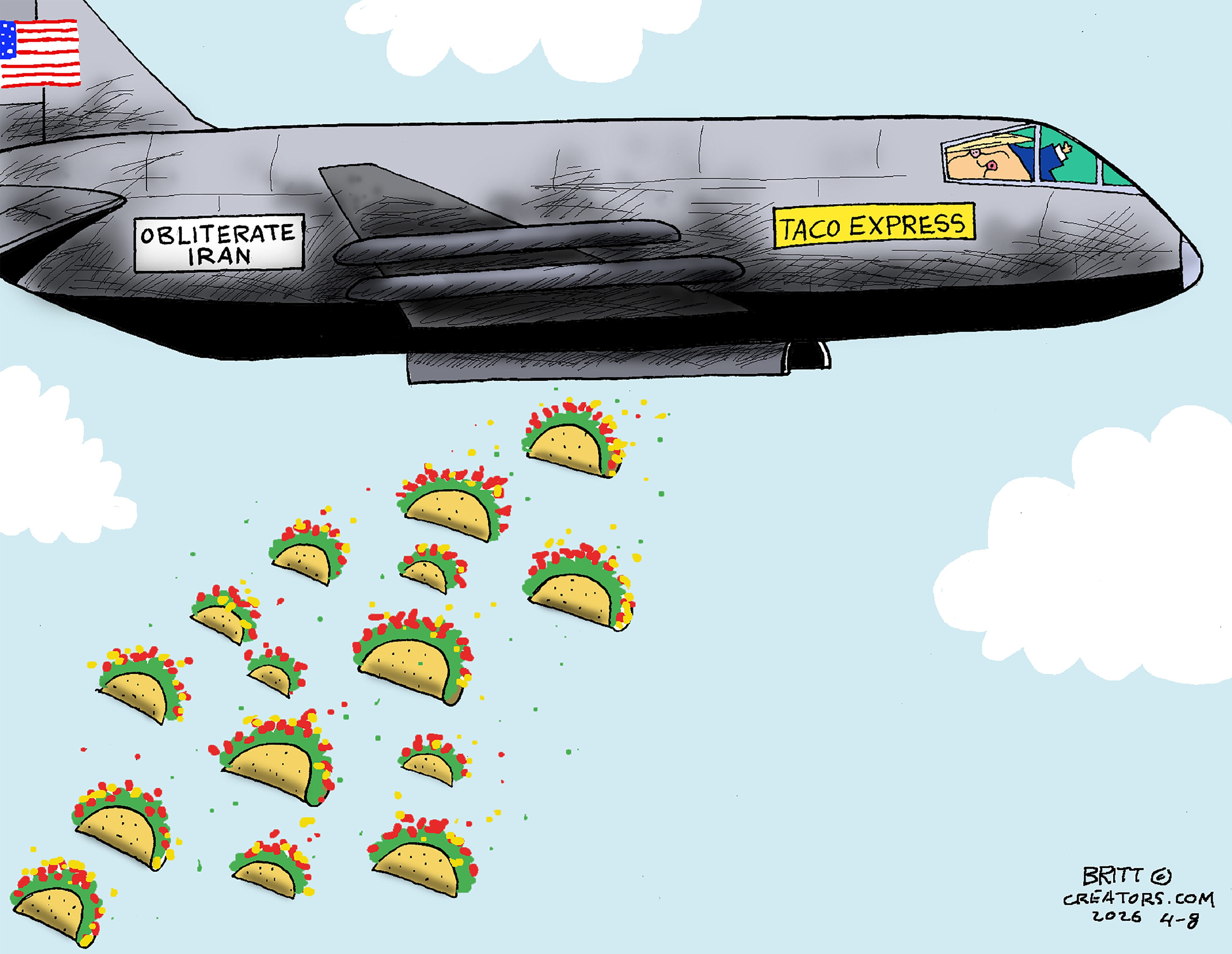
Chris Britt - Creators
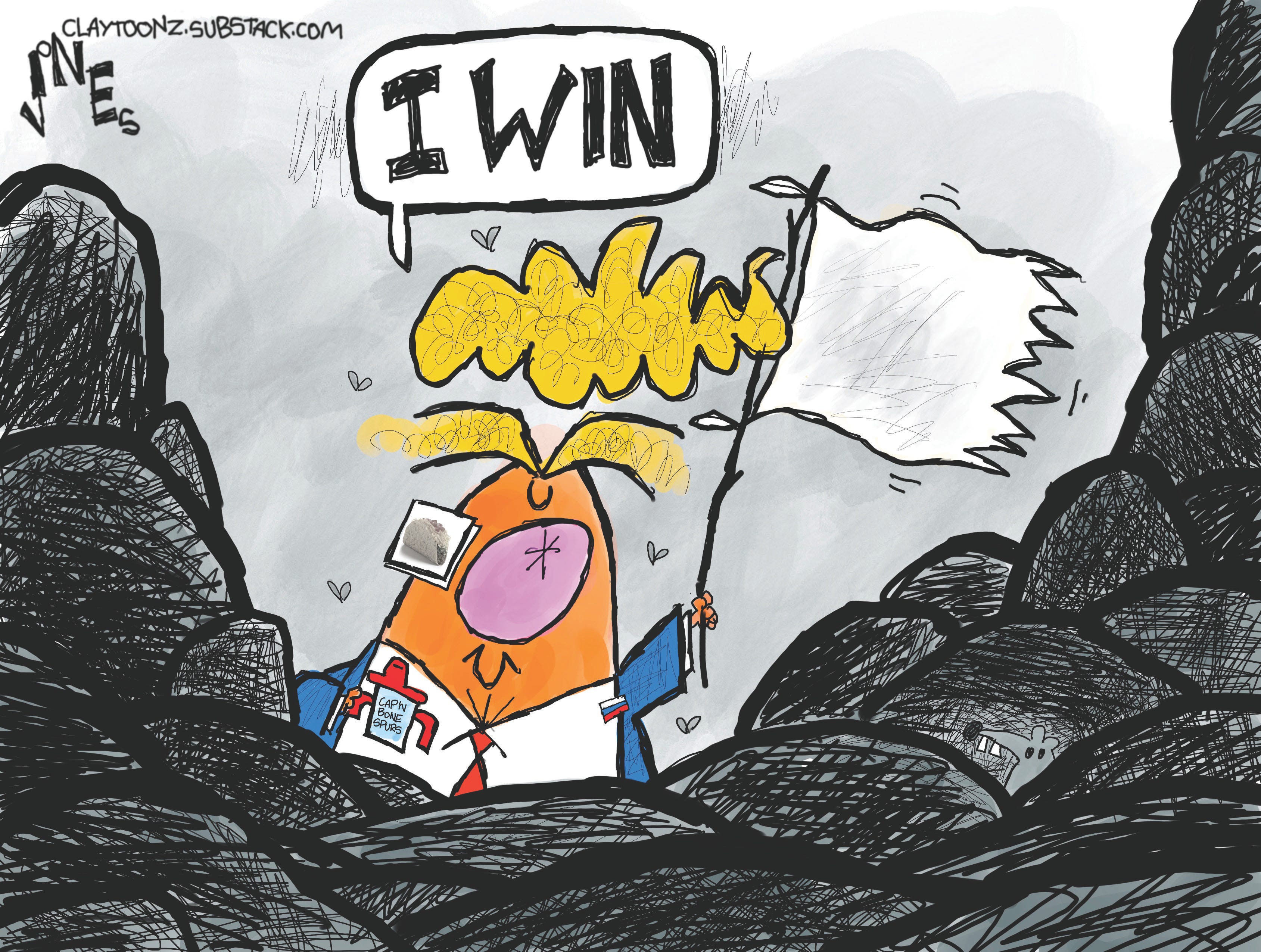
Clay Jones - Substack and Claytoonz
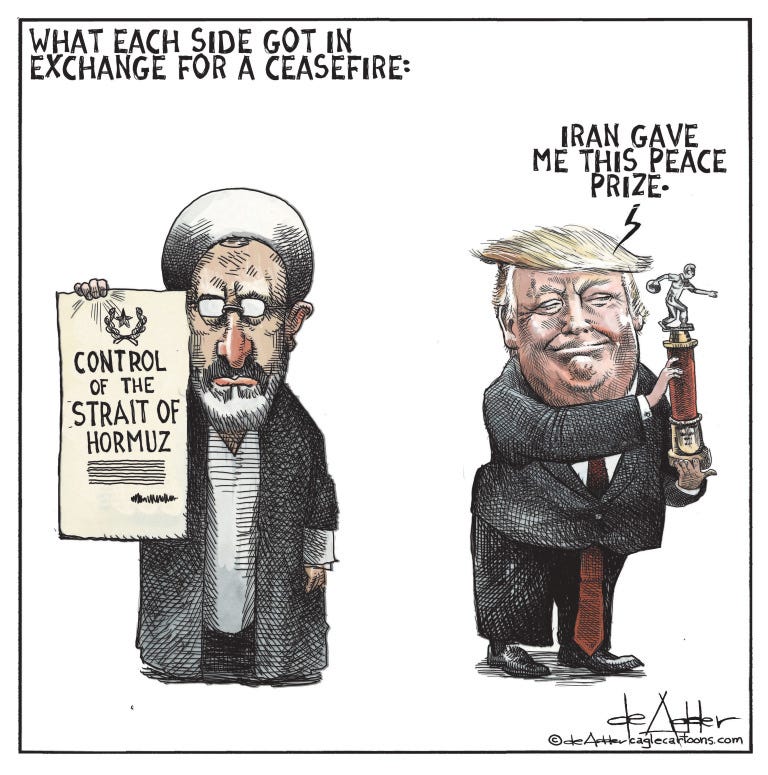
Michael de Adder - cagle.com/de-adder

Bill Bramhall - Tribune Content Agency
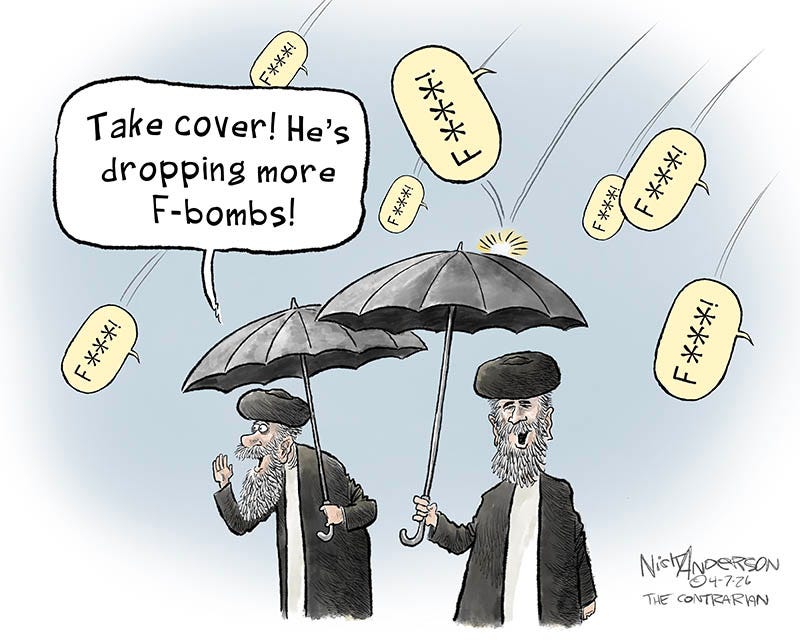
Nick Anderson - Substack and Tribune Content Agency

Drew Sheneman - Substack and Tribune Content Agency

Pedro Molina - Tinyview and Tribune Content Agency

Robert Ariail - Andrews McMeel
Brilliance abounds again. The artworks of Rick McKee, Bill Bramhall, and Pedro Molina were especially on point, though all are terrific.
Love these!