
🚗“Manufactured Pretext” Edition
According to long-standing Border Patrol policy, agents are trained not to turn themselves into hood ornaments and then claim self-defense. That guidance dates back at least to 2014, when an independent review of 67 deadly-force cases found that “some border agents stood in front of moving vehicles as a pretext to open fire.”
The review, conducted by law-enforcement experts, criticized the Border Patrol for a “lack of diligence” in investigating shootings and questioned whether the agency “consistently and thoroughly” reviewed incidents involving deadly force. U.S. Customs and Border Protection—which commissioned the inquiry—then attempted to keep the blistering 21-page report from becoming public.
While CBP and ICE are separate agencies, they share related missions and operate under the same Department of Homeland Security umbrella. If ICE officers aren’t explicitly trained to avoid stepping in front of vehicles, they should be. But the larger takeaway is unavoidable: independent law-enforcement experts identified a culture in which officers were putting themselves in harm’s way in order to manufacture a justification to shoot.
Enter Jonathan Ross, a ten-year ICE veteran, who placed himself in front of Renee Good’s vehicle and then fired three times as she attempted to drive away, two of the shots coming from the side of the vehicle as it passed him. If that sequence doesn’t raise red flags, it’s hard to imagine what would. The Border Patrol policy was designed to prevent precisely the outcome Minneapolis witnessed last week: an officer creating danger, escalating it, and then blaming the victim for basic physics.
Back in 2014, CBP leadership acknowledged the troubling pattern—agents stepping into harm’s way and then pulling the trigger—prompting officials to restate, yet again, that officers should seek cover, create distance, and avoid turning routine encounters into lethal standoffs. The goal was simple: fewer dead civilians, fewer dead agents, and fewer press releases explaining why a bad tactic somehow became common.
As a decade-long federal agent, Ross would almost certainly have been aware of that report and the policy it reinforced. Which suggests his actions weren’t the result of ignorance so much as muscle memory from an ICE culture that treats policy as optional until it’s needed to justify a shooting. Once the bullets fly, suddenly the violation becomes “self-defense,” the training becomes irrelevant, and the policy becomes a historical artifact.
Unfortunatey, the mainstream media has comletely missed the boat on this story. Let’s help them become aware of it.

Clay Bennett - Tribune Content Agency
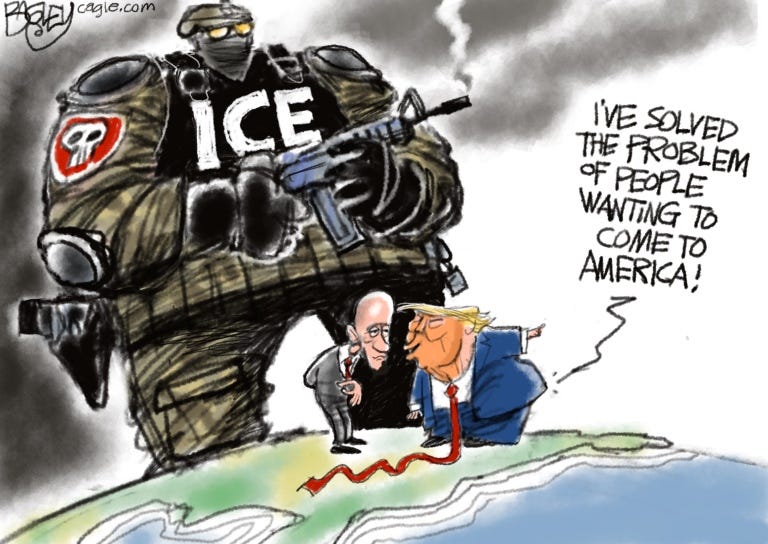
Pat Bagley - cagle.com/bagley
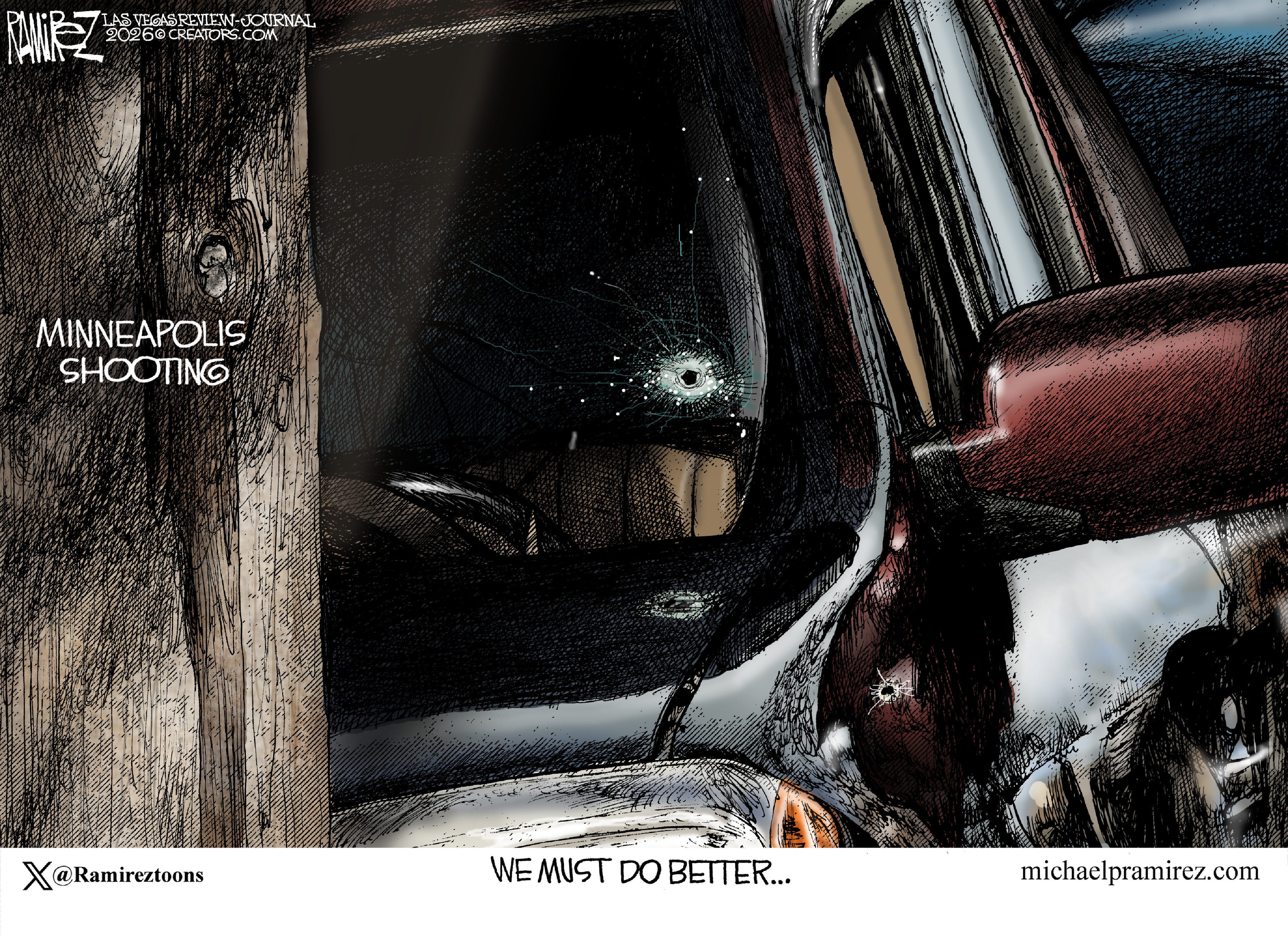
Pat Bagley - cagle.com/bagley
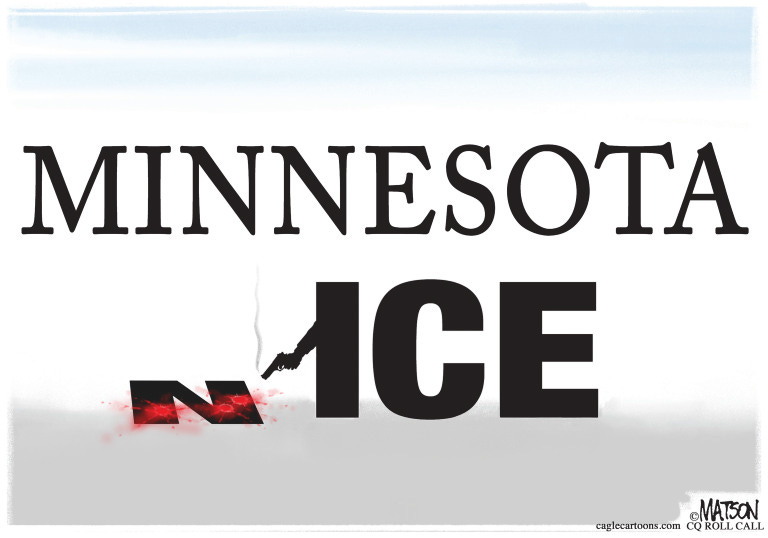
RJ Matson - cagle.com/matson

Matt Wuerker - Andrews McMeel

Matt Davies - Andrews McMeel
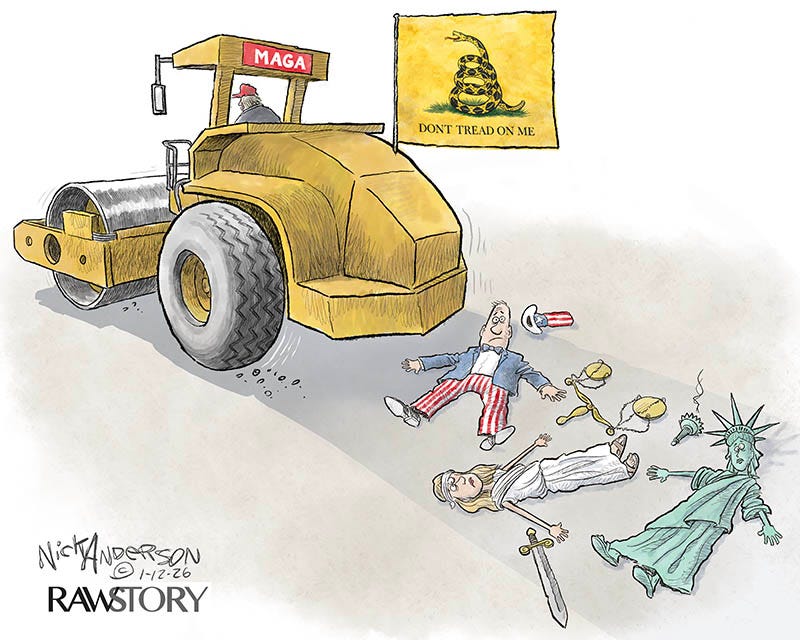
Nick Anderson - Substack and Tribune Content Agency
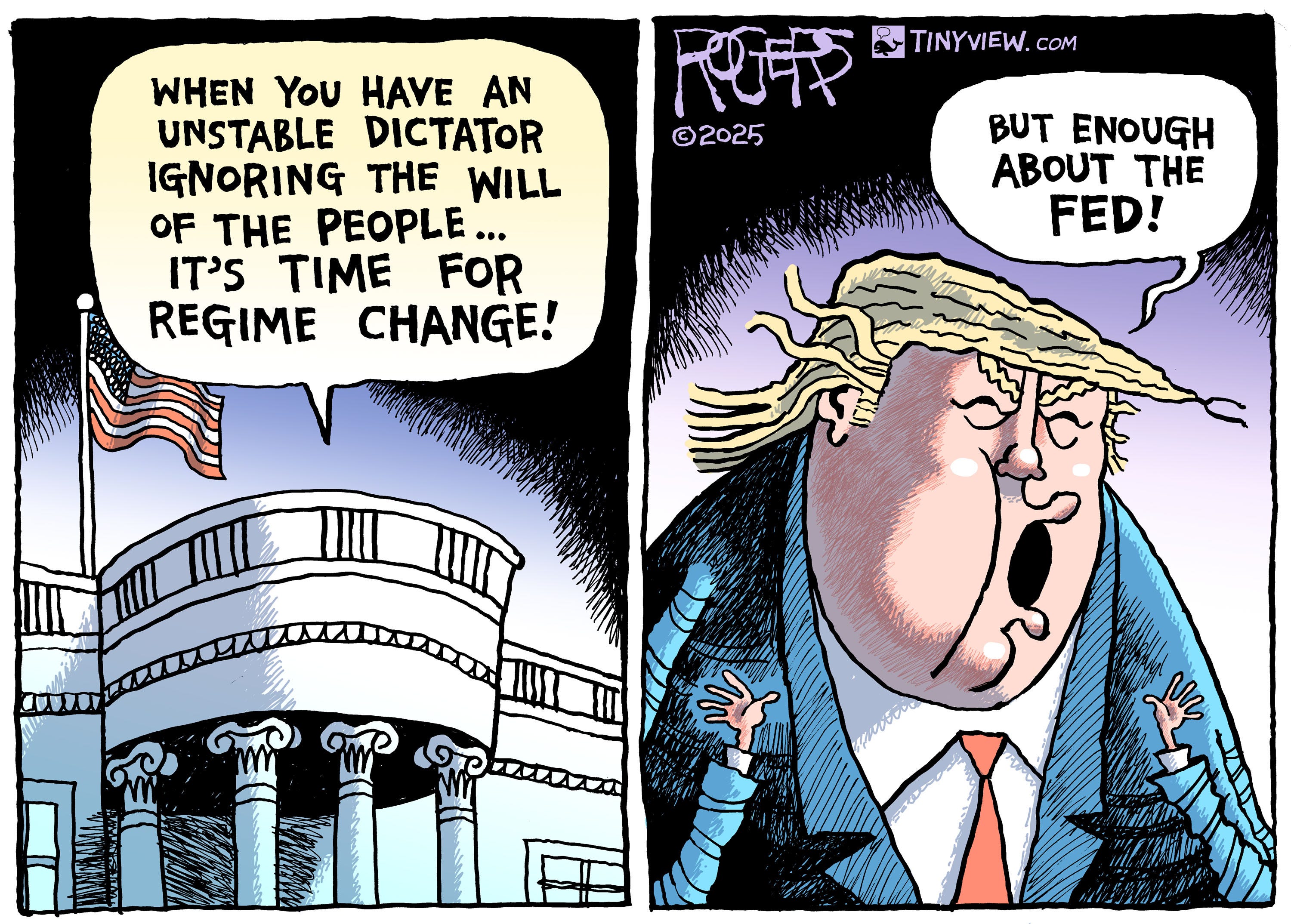
Rob Rogers - Tinyview Comics and Andrews McMeel

Bill Bramhall - Tribune Content Agency
Speaking of pretexts, the Trump administration has discovered that the real threat to American democracy isn’t authoritarianism, corruption, or the president firing officials who annoy him. It’s Jerome Powell’s taste in drywall. After months of publicly calling the Federal Reserve chair a “moron” and a “numbskull” for refusing to juice the economy on command, Trump’s Justice Department has opened a criminal investigation into Jerome Powell over whether he fully briefed Congress on a renovation project that ran hundreds of millions over budget.
Powell, normally the human embodiment of beige wallpaper, finally broke character. In a rare moment of clarity, he explained that the investigation might have something to do with the fact that the Federal Reserve insists on setting interest rates based on inflation and employment data rather than the president’s vibes. The probe, he suggested—politely, calmly, devastatingly—is retaliation for not lowering rates to help Trump’s short-term political needs.
The official rationale is construction oversight. The unofficial rationale is control. This is the same administration that demolished part of the White House without congressional approval now acting as the nation’s foremost champion of fiscal transparency: specifically when it can be used to intimidate an independent central banker. Trump, for his part, claims not to know anything about the investigation, while helpfully noting that Powell is bad at both monetary policy and buildings.
This is all part of a broader campaign. Trump already attempted to fire a Fed governor on dubious legal grounds, installed loyalists eager to slash rates, and now appears to be using the Justice Department as a crowbar to pry open the Fed’s independence. If Powell survives the probe—his term ends soon anyway—at which point Trump can simply install a replacement who understands that “independent” is just another word for “insubordinate.”
Former Fed chairs, economists, and financial adults across party lines have warned that this is how countries wreck their currencies: by turning central banks into political weapons. Markets, for now, are betting that cooler heads will prevail. History, unfortunately, has seen this movie before, usually with subtitles and hyperinflation.
Powell’s two-minute video said what the investigation won’t: this isn’t about renovations. It’s about obedience. And in Trump’s America, if an institution won’t bend, the solution is simple: open an investigation, call it accountability, and wait for the leverage to work.
I like the idea of turning ICE and Border Patrol agents into hood ornaments
The real face of ICE! Thank you, mister Clay Bennett, for this nightmare! Yet, a true nightmare, not a fantasy!