
“I ❤️ Inflation” Edition
President Trump reassured Americans this week that rising prices are actually terrific news, declaring, “I love the inflation” after new data showed consumer prices climbing at their fastest pace in three years.
The statement marked a significant evolution in economic messaging. For years, inflation was described as a devastating national crisis, a crushing burden on working families, and evidence of catastrophic leadership. Now that it’s happening under Trump, inflation has apparently been reclassified as a patriotic hobby.
Americans struggling with higher gas prices, utility bills, and grocery costs can take comfort in knowing they’re participating in something the president genuinely enjoys. Every painful trip to the pump is no longer an economic hardship, it’s a tribute to presidential enthusiasm.
Trump later clarified that his comments were taken out of context and that he actually loves inflation when it is supposedly lower than expected, even as prices continue rising and the Iran conflict pushes energy costs higher. This explanation was immediately added to the growing collection of statements that require a second statement explaining what the first statement really meant.
The administration insists prices will soon “come down like a rock” once the war is over. Economists, meanwhile, note that global supply disruptions and the Strait of Hormuz crisis could affect energy markets for years. But economists make the mistake of studying economics, whereas most politicians simply study polling. Trump, on the other hand, doesn’t study at all.
Perhaps the most remarkable aspect of the episode is how quickly inflation has completed its political journey. Under one president, inflation was proof that America was collapsing. Under another, it’s apparently something to celebrate. At this rate, if prices rise much further, Americans may soon be instructed to thank the cashier for the privilege.
After all, why complain about paying more for everything when the president says he’s loving every minute of it?

Bill Bramhall - Tribune Content Agency

Jack Ohman - Substack and Tribune Content Agency
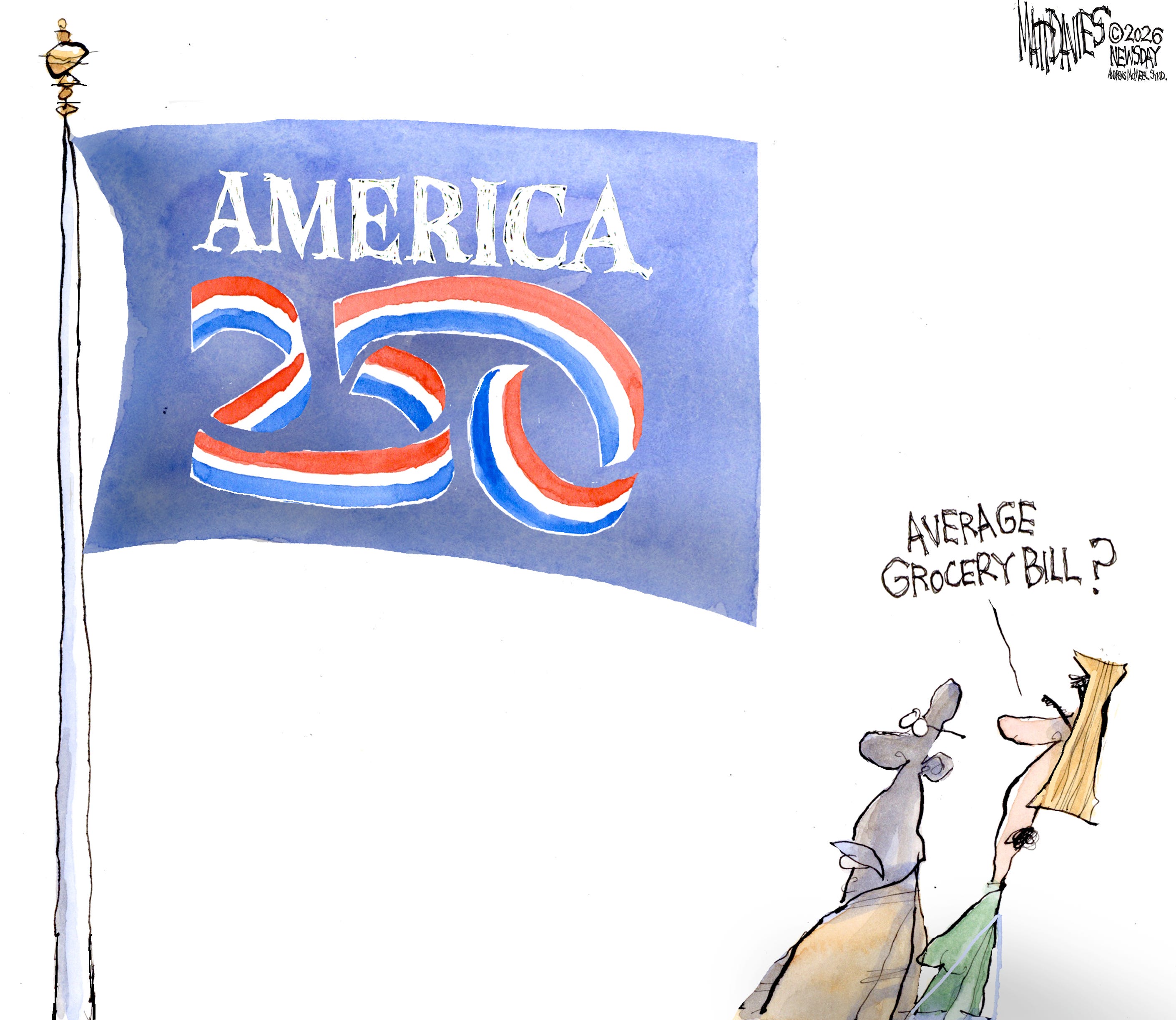
Matt Davies - Andrews McMeel

Rick McKee - cagle.com/mckee

Pedro Molina - Tinyview and Tribune Content Agency

Michael Ramirez - Creators

Nick Anderson - Substack (and editor of Counterpoint)
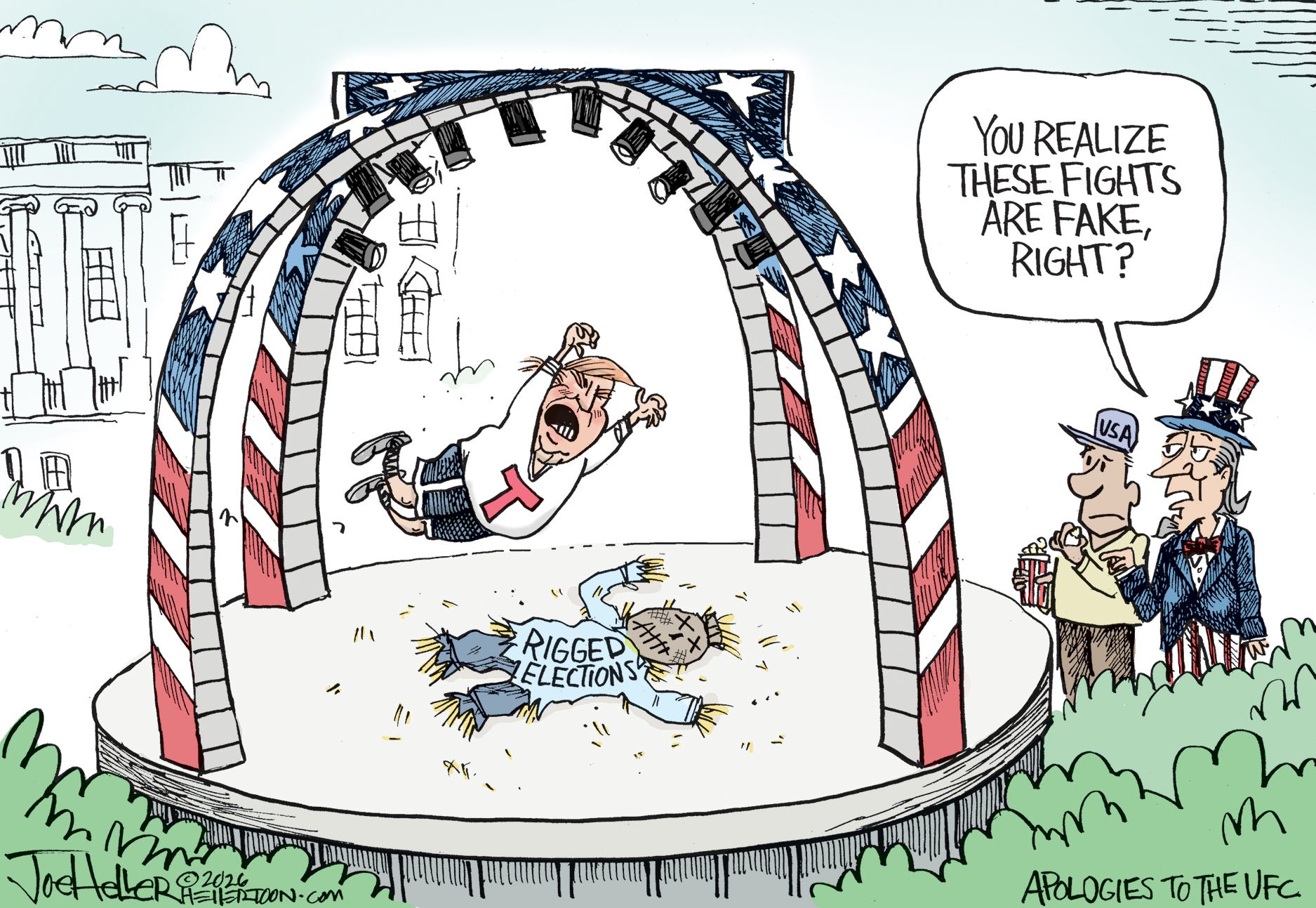
Joe Heller - Hellertoon.com
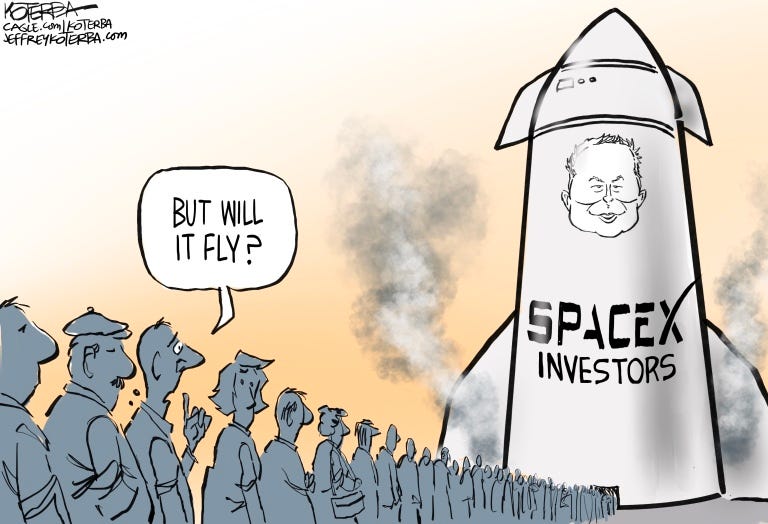
SpaceX is preparing a $1.75 trillion IPO, proving that in 2026 investors have finally solved the problem of gravity by completely ignoring it.
At that valuation, SpaceX wouldn’t just be a rocket company. It would be worth more than the annual economic output of most nations, several planets, and possibly the collective hopes and dreams of every retail investor on Reddit. The company argues that its total addressable market is $28.5 trillion, a figure so large that Wall Street apparently responded by saying, “Sure, why not?” At this point, analysts are only a few PowerPoint slides away from claiming Mars itself should be included in future revenue projections.
To be fair, SpaceX is a remarkable company. It launches rockets, deploys satellites, wins government contracts, and has genuinely transformed the aerospace industry. Unfortunately, none of that answers the question investors should be asking: “How much is too much?” History suggests the answer may be “somewhere south of $1.75 trillion.”
Researchers have found that the largest IPOs in history have produced median losses of nearly 32% one year later. Apparently there is a recurring pattern in which investors become so excited about owning the future that they accidentally pay for the next three futures in advance. Wall Street has discovered a reliable formula: find an extraordinary company, convince investors it will dominate civilization, and then charge them as if it already has.
The Nasdaq reportedly adjusted index rules to help accommodate the offering, meaning passive funds could be forced to buy shares regardless of price. In other words, the investment thesis increasingly resembles, “This stock is worth whatever we say it’s worth because eventually the index fund in your 401(k) will have to buy it.”
The irony is that SpaceX may ultimately justify an enormous valuation someday. But “someday” and “today” are different concepts, despite Wall Street’s best efforts to merge them. Investors seem poised to value SpaceX not as a rocket company, a satellite company, or even a communications company, but as a monopoly on human destiny itself.
And that’s usually how bubbles form: not because the company is bad, but because enthusiasm becomes detached from mathematics. At $1.75 trillion, investors aren’t buying a stock. They’re buying a front-row ticket to the Second Coming of Capitalism and hoping somebody even more excited is sitting behind them.
History suggests that a year from now many of those investors may discover an important truth about space travel: what goes up can, in fact, come back down (or explode on the launch pad).
It's amazing how much cogent commentary, wit, and skill can fit in each small section of the brilliant offerings you all grace us with every day. Thank you.
Spot on toons, kindly keep them coming to help us thru these trying times. The current admin is trying to take away everything we have including our sense of humor.